
Because of its widely distributed nature, the puzzle community tends to lack universal terminology. (Shout-out to Mari Black and Jim Eakins for their Terminology Tuesday videos like this one trying to explain terms.) Try searching for “puzzle cuts” online and you’ll find conflicting definitions and long arguments about how many types of cuts there are and what each one is properly called.
Based on info from numerous puzzle manufacturers, puzzlers, and other sources, here’s my take on the most common types of puzzle cuts. If you disagree with any of my info or you’re aware of other puzzle cuts, please contact me at karen@puzzles.blog.
Ribbon Cut (or Grid Cut) Puzzles
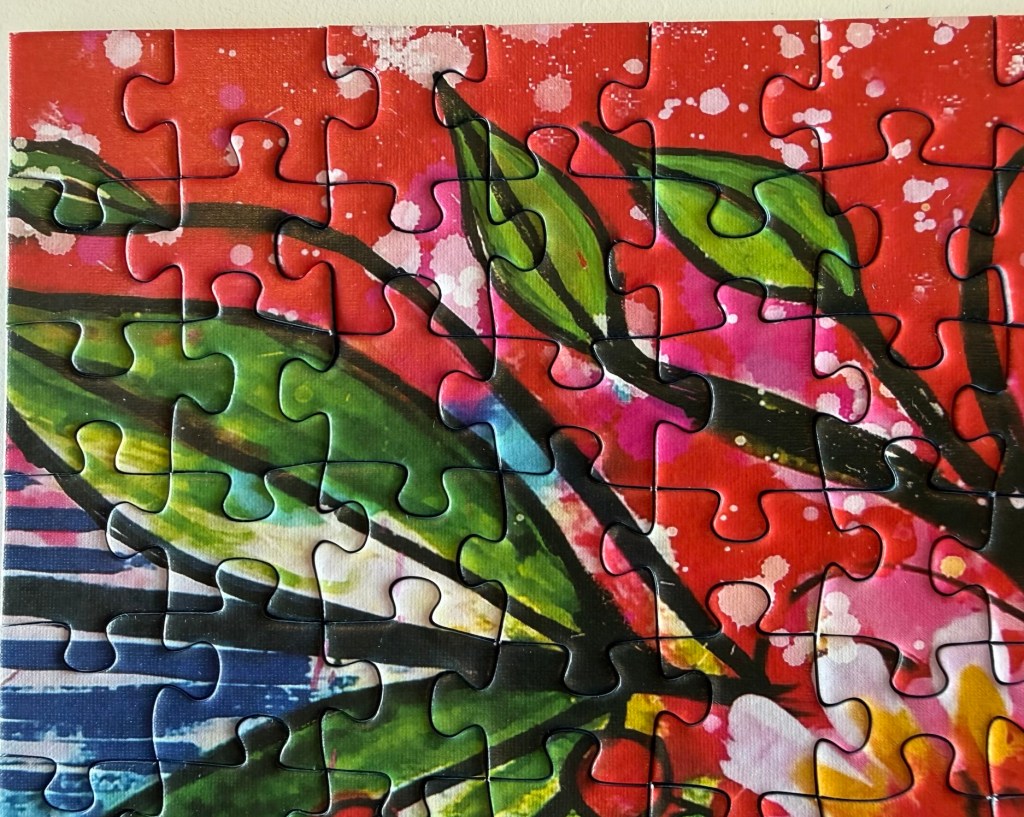
There’s no consensus on whether ribbon cut and grid cut are the same. “Ribbon cut” is the term I hear most often. An example from Ravensburger is shown below. The puzzle is cut so that each piece has four sides and where four pieces are together, their corners meet.
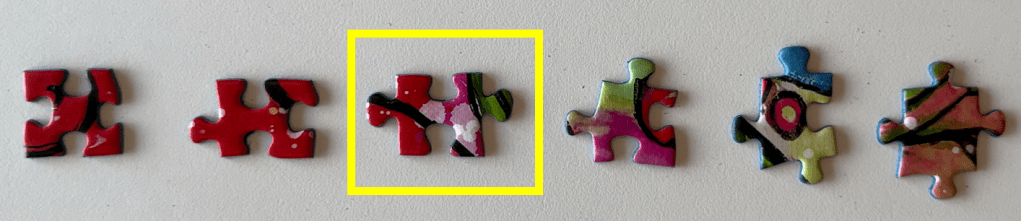
People sometimes differentiate ribbon cut and grid cut based on the piece shapes. For example, the six pieces below illustrate the six piece shapes from the interior of the above puzzle. Most people call this a ribbon cut, but some puzzle pundits, manufacturers, and vendors (including Galison and Puzzle Warehouse) think of ribbon cut as using only one piece shape in the interior: the one outlined in yellow.
Others say that grid cut puzzle pieces always meet at their corners but that not all ribbon cut puzzle pieces meet at their corners. I’d show you an example of the latter, but I can’t find any in my puzzle inventory, which makes me think they’re not common.
In my daily puzzling, I’ll be using the term “ribbon cut” to refer to a puzzle where each of the pieces is roughly shaped like a square or rectangle and where each non-edge side has either one “out” (knob) or one “in” (hole).
Random Cut Puzzles
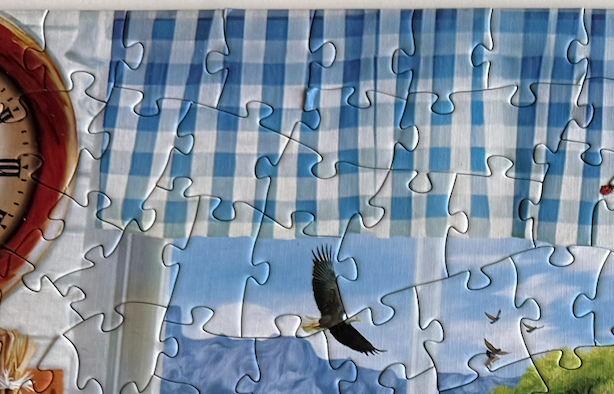
Random cut puzzles are easy to differentiate from ribbon/grid cut. The example below shows part of a MasterPieces random cut puzzle. Notice that while some of the pieces look similar to ribbon cut, others are much different, like having five sides or having multiple “ins” and “outs” on a single side. Also, many of their corners don’t align.
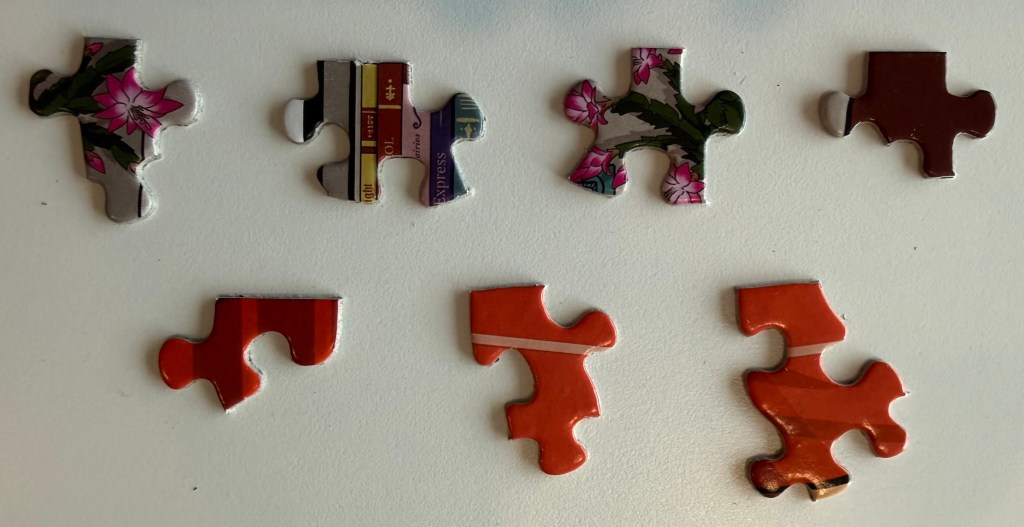
In the example above, it’s pretty easy to distinguish the edge pieces from the others. But some random cut puzzles make that more challenging. Below there’s a sample of pieces from a Springbok random cut puzzle. Although each of these has a straight side, not all of them are actual edge pieces.
Circular Puzzles
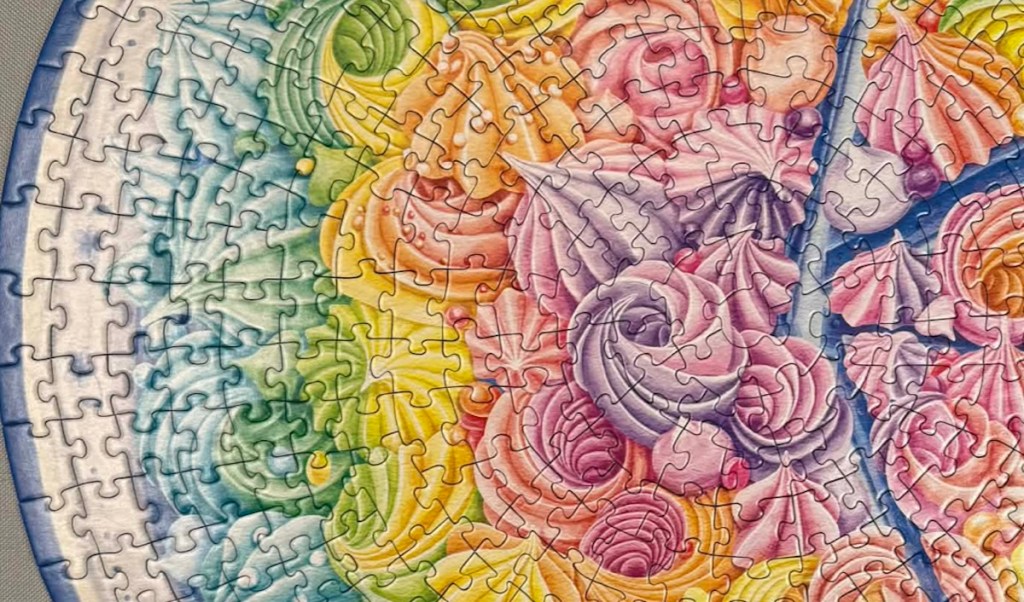
Some puzzles are circles, and that affects the cut of their pieces. Below is an excerpt from a Ravensburger circular puzzle (thanks to Christina Nielsen for the picture.) The center of the puzzle is inside the pink and purple area on the right. Notice that the pieces near the center are random cut, with strange shapes and a great deal of curvature. But the outer part of the puzzle, on the left side of the picture, is ribbon/grid with just a little curvature. So this circular puzzle has both ribbon/grid cut and random cut pieces.
Family Piece Puzzles
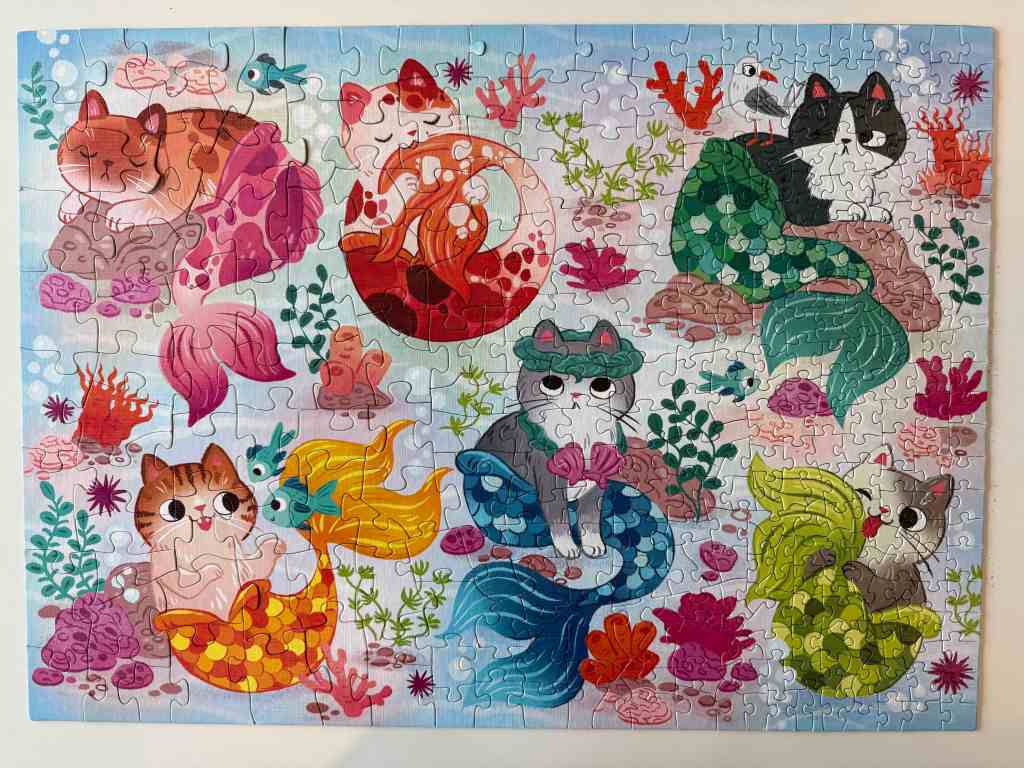
Family piece puzzles use a form of random cut where the size of the pieces varies from one end to the other. This allows family members to each work on the part of the puzzle that’s best suited to them. An example of a family piece puzzle from Cobble Hill is shown below. It has large pieces on the left, medium pieces in the middle, and small pieces on the right.
Whimsy Cut Puzzles
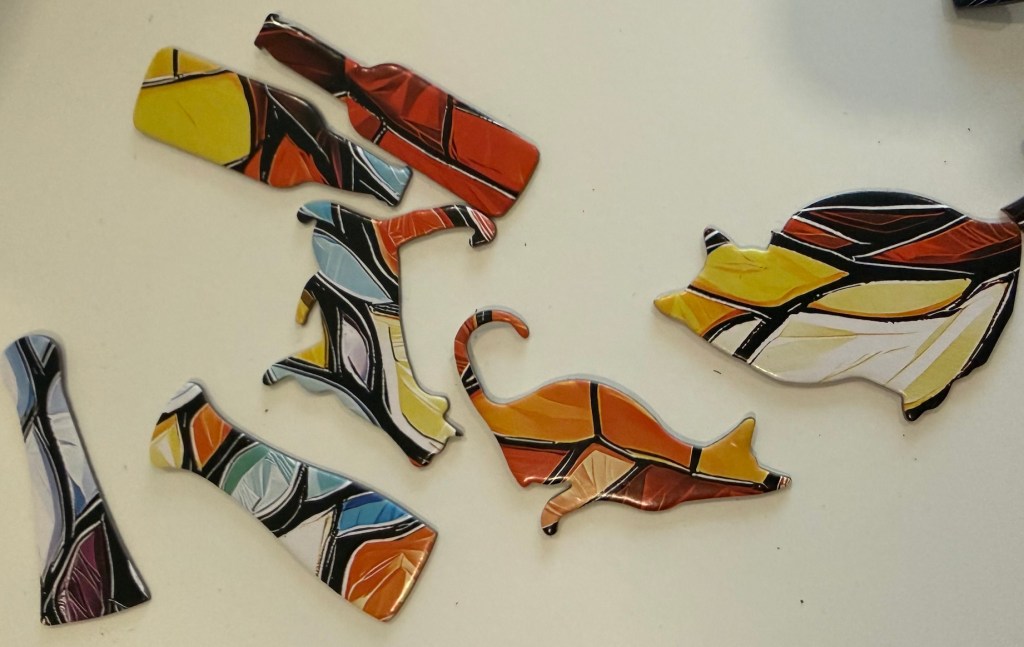
Whimsy cut puzzles are another form of random cut puzzle; they have some pieces with unusual shapes that may or may not be related to the puzzle’s art. I’ve only come across one puzzle with whimsy cut pieces, and unfortunately it wasn’t well-designed so the pieces wouldn’t stay together. But I did take a picture of its cat- and bottle-shaped pieces.
 Puzzled.blog
Share your puzzled thoughts!