
I recently competed in the 2026 DC/Maryland/Virginia speed puzzling championship organized by speedpuzzling.com. One of my favorite events was pairs relay. It’s super fast and intense, and it’s hard to beat the adrenalin rush. But it can be overwhelming if you’re new to it.
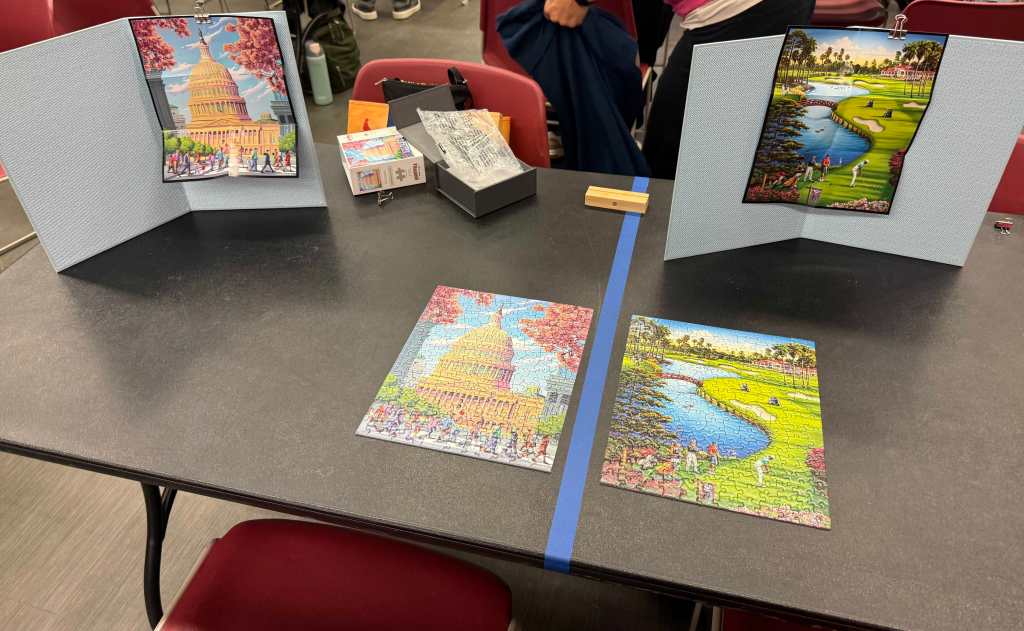
In pairs relay, the two partners have a six-foot table divided in two, with a different 200-210 piece puzzle on each end of the table. One partner sits in front of each puzzle. When time starts, each partner works on their respective puzzle for five minutes. The timekeeper will announce, “Switch!”, and the partners switch ends. This repeats every five minutes. Once one puzzle is done, that partner can give verbal instructions to the other partner and point at things, but can’t touch the other puzzle until the next switch occurs. It’s hectic and harried in such a fun way.
Below is a picture of our completed pairs relay puzzles (38:20) from the championship. Christina and I were comfortable as a pair because we’d done the event together before. And before the first time we competed, we did a practice session to figure out the movement logistics.
Some pairs choose to sit on the same side of the table and change places for each switch. It can take a little practice to make this swap smoothly, with one person quickly moving directly from one chair to the other while the other person stays out of their way by exiting their chair on the other side and walking around to reach the other chair. The main advantage of this method is that both puzzles are right side up for the pair at all times.
Other pairs have one person on each side of the table at opposite ends (top left and bottom right, or bottom left and top right). When “switch!” is called, each person moves to the other chair on their side of the table. The advantage of this is it minimizes the time needed to switch. The disadvantage is that the puzzles won’t be right side up at all times. Some pairs build their puzzles sideways so that no one has to work on an upside-down puzzle.
Also, no matter what your seating arrangement is, you have to be prepared to adjust it at competition time because there will be tables and chairs all around you with other pairs. You might have someone sitting directly behind you, and you might inadvertently bump into or block each other. Ideally you’ll have time to talk with the pairs near you so everyone can minimize potential problems before the event starts.
All of the movement planning aside, what makes pairs relay so much fun is that you’re usually going to be surprised by what you find when you switch back to a puzzle. Maybe your partner has done some cool sorting, made a bunch of progress in assembly, or finished a tough element that you were hoping to avoid. Five minutes later, you get surprised again. And jumping back and forth between puzzles takes a great deal of concentration.
One caveat if you’re going to practice pairs relay on your own: you’ll have to find a timer that you can set to go off every five minutes. This is easier said than done. In a future article, I’ll be talking about options for five-minute timers, both physical devices and smartphone apps. If you have any suggestions for pairs relay timers, please comment below or contact me at karen@puzzled.blog.
 Puzzled.blog
Share your puzzled thoughts!