
New speed puzzlers are often intimidated by seeing the times that other puzzlers post, and I’m here to tell you: time is an illusion. Puzzle times, doubly so. (Thank you, Douglas Adams.)
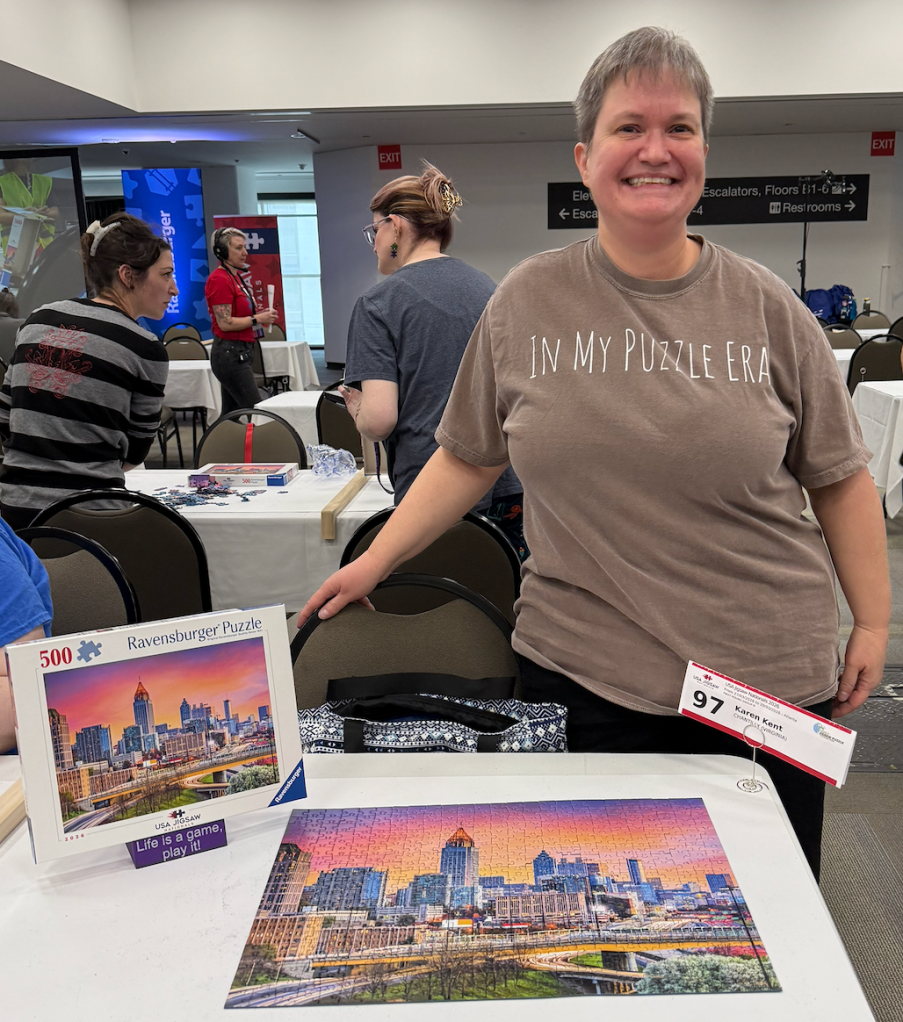
I recently competed in my first USA Jigsaw Nationals. I wasn’t going to sign up because I didn’t think I belonged. I was often taking two hours for a 500-piece puzzle, while the best were doing puzzles in 30 minutes. Even after four months of daily training, I still exceed two hours sometimes. My best times and my average times have gotten significantly better, though. And I finally recognize that my performance can and will vary wildly from one puzzle to another based on several factors, including:
- how I’m feeling (mentally and physically)
- what the environment is (bad lighting, interruptions, etc.)
- what the puzzle is
The last one is a lot more important than I realized when I started. And now I have data to support that. At Nationals, I competed in solo prelim heat B. The four heats were held on the same day in the same space, each one with 200 people chosen essentially at random from the pool of 800 competitors. Each heat had its own puzzle. The table below lists for each heat the fastest time, the time in 50th place, and the time in 100th place.
| Solo prelim heat | 1st place | 50th place | 100th place |
| A | 36:24 | 55:46 | 1:10:03 |
| B | 36:27 | 1:01:49 | 1:18:10 |
| C | 33:19 | 57:51 | 1:11:27 |
| D | 30:39 | 59:20 | 1:14:25 |
Heat B had the highest times for 1st, 50th, and 100th place finishes. Since the room conditions were the same for all heats, this indicates that the puzzle in heat B was more challenging than the other heats. (Lucky me.) I finished in 1:19:59, in 105th place for the heat, and I’m thrilled with how I did! But the differences between heats got me thinking…how would I have fared in the other heats?
This is where things get interesting. I calculated the differences between the 1st place and 50th place times, and between the 50th and 100th place times. The table below shows the increases in time to the nearest percent. For example, in heat A the time for 50th place (55:46) was 53% higher than the time for 1st place (36:24).
| Solo prelim heat | 1st to 50th | 50th to 100th |
| A | 53% | 26% |
| B | 70% | 26% |
| C | 74% | 24% |
| D | 94% | 25% |
The rightmost column shows that the increases in time from 50th place to 100th place are all around 25%. However, the middle column shows increases from 1st place to 50th place ranging from 53% to 94%. This shows the dangers of basing your expectations on the times of the fastest puzzlers, because they do not correlate strongly with the performance of most competitors. Also,
Comparing my heat B time (1:19:59) with the 1st place time (36:27), mine was 119% longer. That feels so discouraging. But my time was only 2.3% longer than the 100th place time (1:18:10) and 29% longer than the 50th place time (1:01:49).
If I’d been in heat A, odds are my time would have been more like 1:12:00. My gut reaction would have been to be even happier with that lower time, even though I would have puzzled just as well in each heat.
I try to measure my progress not by chasing the fastest puzzlers, but by looking at how I compare to the other mortals. At Nationals, I was solidly average in solos, which is a huge win for me…that and having the time of my life in puzzle geek heaven!
 Puzzled.blog
Share your puzzled thoughts!